
Built to Be Run
A Demand Generation Playbook for the Agentic Era
You've probably heard people say that using AI for marketing will help you find buyers, create content, and handle follow-ups. Some of that is true, but it only works if your marketing is already organized as a system that an agent can run.
This means having clear processes, current data, and repeatable steps that move a buyer from stranger to client, so both people and machines know what to do next. Without that, AI won't solve your problems. It will just make them bigger and faster than you can manage. This guide will show you how to avoid that and what to build first, so AI actually helps you instead of making things harder.
This is not just a guess about the future. The software your business uses is already changing. For example, in April 2026, Salesforce made its entire platform accessible to software agents, so you no longer need a browser. They said the real value was always in the data and logic, not the screen. If the world's biggest CRM is shifting to what machines can use instead of what people click, your business will have to adapt too. Here's what that means if your business has grown through referrals.
First, this is a practical guide, not more AI hype. Instead of just listing tools to buy, it focuses on where AI can really help and what your business needs to set up first.
If a buyer researched your firm today without ever calling you, what would they find?
Before you read another line, go find out. Open ChatGPT or Perplexity and ask two questions: "What does [your firm] do, and who is it best for?" and "Who are the best [your service] providers in [your city or niche]?" Read what comes back, or what doesn't, before you continue.
As you look at the answers, notice what shows up for your firm. Do the responses match what you really do? Are you mentioned, or do competitors appear instead? If the answer is missing, wrong, or points to someone else, write down where the gap is, whether it's about being seen, being clear, or being trusted. Use this as your starting point. These gaps show what you need to improve in your public presence and messaging. The goal is to make sure both buyers and the AI tools they use can find you, mention you, and describe you accurately. This is your first clue about what needs work.
You'll likely see one of four results: nothing, something incorrect, a competitor instead of you, or a made-up answer. This isn't just bad luck. In 2026, a study of nearly 7,000 real buyer questions across major AI tools found that brands appeared in only about 15% of the answers. For professional services, it was even worse: eighty-six percent of firms were never mentioned.
When an AI names a competitor instead of you, there's a reason. Sometimes it recognizes your name but links to a competitor's page because it doesn't trust your content enough to quote it. Being known isn't the same as being cited, and only being cited brings buyers to you.
Being known isn't the same as being cited, and only being cited brings buyers to you.
If the AI describes you correctly and completely, you're in a small group that's already clear to it, and you're ahead of most similar firms. Your next step is to figure out why it worked and make sure it stays that way, since the same issues that hid the other eighty-six percent are still out there.
I tried this same test on my own firm, Marketing Systems Guild, before asking you to do it. One AI described me as someone who builds and runs systems. Another called me an advisor but didn't list my firm as one buyers should hire. A third copied the style of other fractional marketers and presented it as my approach, even though it wasn't true. Same company, three different answers, all delivered confidently by the AI, with no sign of doubt. If AI can be this inconsistent and sure of itself, even when it's wrong, about a company that specializes in this work, it's important to know what it says about yours.
Here's the catch: referrals never made you visible to buyers outside your network, and that's where a steady flow of new business comes from. Now, those buyers check you out using AI before they ever contact you.
The numbers say this is already the norm, not the future. In Forrester's 2026 survey of roughly 18,000 business buyers, 94% used AI at some point in the purchase journey. Forrester also finds that about 61% of the journey is completed before a buyer ever contacts a vendor. AI answer engines have passed company websites and sales reps as the top place buyers go to research who to work with. HubSpot's Kieran Flanagan argues that optimizing for AI engines is the new version of optimizing for search, and Gartner projects that by 2027, close to ninety-five percent of B2B journeys will begin inside an AI assistant.
Is this just another marketing-technology cycle I can wait out?
Yes and no. What matters most is the no.
Good content teams have always followed one rule: write for both robots and people. That hasn't changed. Search crawlers were always non-human readers. What's different now is what the robot does. It used to just file your information. Now, it quotes you.
The old search crawler just indexed your page and sent people to read it. The new AI reads your content, summarizes it, and answers buyers' questions for you, often before they visit your site. The non-human reader has changed from being a librarian to being a narrator.
The non-human reader has gone from being a librarian to being a narrator.
That's the real difference, and it's why you can't just wait for things to go back. Now, you're not just trying to be found. You're making sure you're quoted accurately by something that speaks for you.
You saw a clear example of this on the cover. When Salesforce made its whole platform accessible to agents and made the browser optional, the company admitted that the real product wasn't the interface. It was the organized data and clear logic underneath.
Now, software and companies are judged by one question: are you callable, with clear inputs and outputs, or just clickable, with screens only people can use? Only callable systems are ready for what comes next.
We keep hearing, "AI will do my marketing for me." Will it?
Not in the way you might expect. Here's what's really happening: an agent takes on your existing operating model. It doesn't create one for you.
An agent takes on your existing operating model. It doesn't create one for you.
If you give an agent a messy process and bad data, you won't get real automation. Instead, you'll get a machine that makes mistakes quickly and confidently, again and again. Remember:
AI doesn't slow down for bad data. It just spreads it faster.
This isn't just a minor concern. Gartner predicts that about 60% of AI projects will be abandoned by 2026, not because the AI doesn't work, but because the data underneath was never ready. Forrester also expects that ungoverned AI will cost B2B companies over $10 billion in 2026, due to mistakes, lost value, legal issues, and fines.
For a firm like yours, this is straightforward. Right now, your operating model might just be a mix of disconnected tasks and one-off tactics, not a real system. For some, everything is in the founder's head or based on referrals. For others, it's just a set of tools. But that's not something an agent can run. To use agentic automation, you need a clear, repeatable process: clean data about your clients, a written path from stranger to conversation, and clear steps in and out. For example, an IT services firm might have a process where a prospect fills out a contact form, gets an automated email, schedules a discovery call, and then receives a follow-up summary that's logged in the CRM. Every step is mapped, written down, and assigned, so anyone or any agent can run it the same way every time. An agent follows a process. If there isn't one, there's nothing for it to do.
There's an even bigger trap than starting from scratch. Many firms have a CRM, a newsletter, and some ads, but nothing ties them together. The messy, half-connected data looks like a foundation, but it isn't. A new marketing leader often inherits this and is told to "add AI" on top, which just means automating the mess even faster.
Write down your last five wins and how each client found you. Then look for two patterns. First, how many came from the same two or three people? You'll probably notice that most of your business comes from just a few relationships. That's a risk: if one of them leaves, part of your pipeline goes with them. Second, can you explain why each client chose you, besides "someone recommended us"? If not, you're relying on borrowed trust, which you can't increase when business slows, can't teach to a new hire, and can't hand off to an agent. That's what it means when we say "an agent inherits your operating model." If there's nothing to inherit, there's nothing for the agent to do.
Referrals have always been enough. Why change now?
Start with what a referral actually is, in demand terms. Marketing has two jobs. Demand capture meets the buyers who are already looking and converts them before a competitor does. Demand creation reaches buyers before they are looking, expanding the pool. Capture plateaus, because only so many people are searching right now. Creation compounds, because every asset keeps working and the audience and authority stack over time.
A firm that grows only through word of mouth is not doing either job well. A referral is a weak, passive way to capture demand: you catch the demand that happens to come your way, and you create almost none yourself. That's why referral-led growth feels stuck. You are using a pool you never refill, running on a flat curve with no growth beside it. It worked because others kept adding to the pool for you. In an AI-driven market, that support is what disappears.
A referral-only model has three quiet failures, all already happening.
The warm intro now gets cold-checked. When someone refers you, the buyer no longer takes the intro at face value. They validate you in an AI assistant before the call. Buyers now run validation in both directions, human and machine, and the machine pass usually happens first. If you are invisible there, the referral loses its heat before you ever hear the phone ring.
You have no backup plan. When referrals slow down, and they always do, there is nothing else to rely on because you never built the demand creation side. Capture alone will always level off. You just couldn't see the limit while introductions kept coming.
You can't hand things off. A business that only the founder can market is a business only the founder can run. What feels like a strength, that everything runs through you, is actually what limits your growth.
This matters more in your field than in most. If you run an MSP, an IT-services firm, or a compliance-focused practice, your buyers are naturally cautious and do a lot of independent research before making a decision. Now, that research starts with AI tools. The reputation you worked hard to build is being checked by a machine before a person ever reaches out.
So what does a firm that is actually ready look like?
It's not about buying the right agent. It's about having a demand engine that works as a system. Stop asking "which tool" and start asking if your marketing has these four things. It's clear — anyone, human or machine, can find you and understand what you do and who you help, just by reading your information. It's measured — you can see who's in your market, what they interacted with, and what led to a conversation. It's defined — the steps from stranger to first conversation are written down, not made up each time. And it's ready to run — the written process can be followed by a person and, in the future, by an agent, without needing to rebuild anything.
Here's the main point: your marketing department is either just a set of screens only people can use, or it's a real system. Only a system is ready for what's next.
Rate yourself on those four points. For each one, answer honestly with yes or no. Can a stranger find and understand you? Can you see what's happening? Is the process written down? Could someone or something else run it? Any "no" isn't a failure, it just shows you what to work on next, step by step.
If I have no marketing function, or one person and some half-wired tools, where do I start, and in what order?
You start in the same place, no matter what. The only difference is your first step. If you're starting from scratch, begin by building. If you already have a junior hire, a new marketing leader, and some tools, start by reviewing what you have and removing anything that doesn't connect. The steps are the same; only the starting point changes.
If you're the marketing leader, this order is also your case for the budget. Budget pressure is real, and it's tempting to ask for more. But a tight budget actually helps you focus on making your current tools and spending work together before adding anything new. Seen this way, the real challenge is alignment, not limitation. It puts you and the owner on the same team, both asking, "Is what we have working?" instead of arguing for more. The problem isn't a small budget; it's not having a clear system. Kieran Flanagan and Kipp Bodnar from HubSpot say the same thing: modern teams win by learning and shipping faster, not by spending more.
Here's the order. Each step builds on the one before it, so don't skip ahead.
Step one: fix your foundation before building a funnel. Clean up your records of who you serve and who you've worked with. This can be as simple as a spreadsheet, a document, or even a paper list. The goal is to have all names, notes, and outcomes in one place so you can see your best clients and spot patterns. Ask yourself five questions about your data: Who are my best clients? Why did they buy? What do they have in common? Who else is like them? What's the next step for each? Any gaps in your answers show what you need to build. You can't measure or automate if you're just guessing.
Step two: make your firm easy to find and understand for both people and machines. Take your three best client wins and share them as plain, clear text: include the client type, the problem, and the result. Don't use fancy PDFs, images, or gated case studies. Post these stories in simple text on your website, blog, or LinkedIn, places where buyers look. The goal is to put this information where both people and AI tools can easily find and use it. Answer the real questions buyers ask, using their words. This is the kind of content AI engines pick up, so one good, original story is better than lots of generic ones.
Step three: define one repeatable process. Choose a single path from stranger to first conversation and write it down until you can run it the same way twice. Don't try to build a complex funnel with lots of channels. Pick the one path you can actually manage this quarter, and focus on that until it works consistently.
Step four: measure your process. Add tracking so you get real data, not just guesses. Decide on two or three key numbers that show it's working before you spend money to scale up.
Step five: make it callable, then automate selectively. Only now do agents earn a place by running a process that is already defined and measured, rather than inventing one. The test is simple: if a new hire could not run this path from the written version, an agent cannot either.
None of this is glamorous, and that's the advantage. It's also the work I see skipped most often. The visible move is more tempting: a new agent or another ad campaign, so that's where the money tends to go first. The firm that builds the unglamorous foundation first is the one the machine can actually find and cite, and the one whose pipeline holds steady during a slow referral quarter. Your competitors' impatience is your opportunity.
Who is actually operating this way, rather than just talking about it?
Fair question, and here is a straight answer. Let me show you something rarer than a case study: a marketing department that runs itself, operated by one person, that I will open up and show you under the hood.
After more than twenty years in demand generation, I built this engine for my own firm, Marketing Systems Guild, the way this playbook prescribes. It is a defined, instrumented, callable system that I install and run myself. Two agents do the work against a live stack: prospect research, ideal-client scoring, and marketing audits. It is neither a pilot nor a certification. It is how the shop runs, day to day.
Under the hood, here is what that looks like. Over a thousand companies have already been scored and tiered against a defined ideal-client profile automatically, before I ever look at any of them. A full marketing audit runs across six dimensions: content operations, CRM and data, ideal-client definition, lead routing, attribution, and sales-and-marketing alignment, in a single pass, the kind of review that normally takes days of manual work. Five tools, HubSpot, Apollo, LinkedIn, GA4, and Google Tag Manager, are wired to one operator through a shared connection layer, with the two agents doing the work.
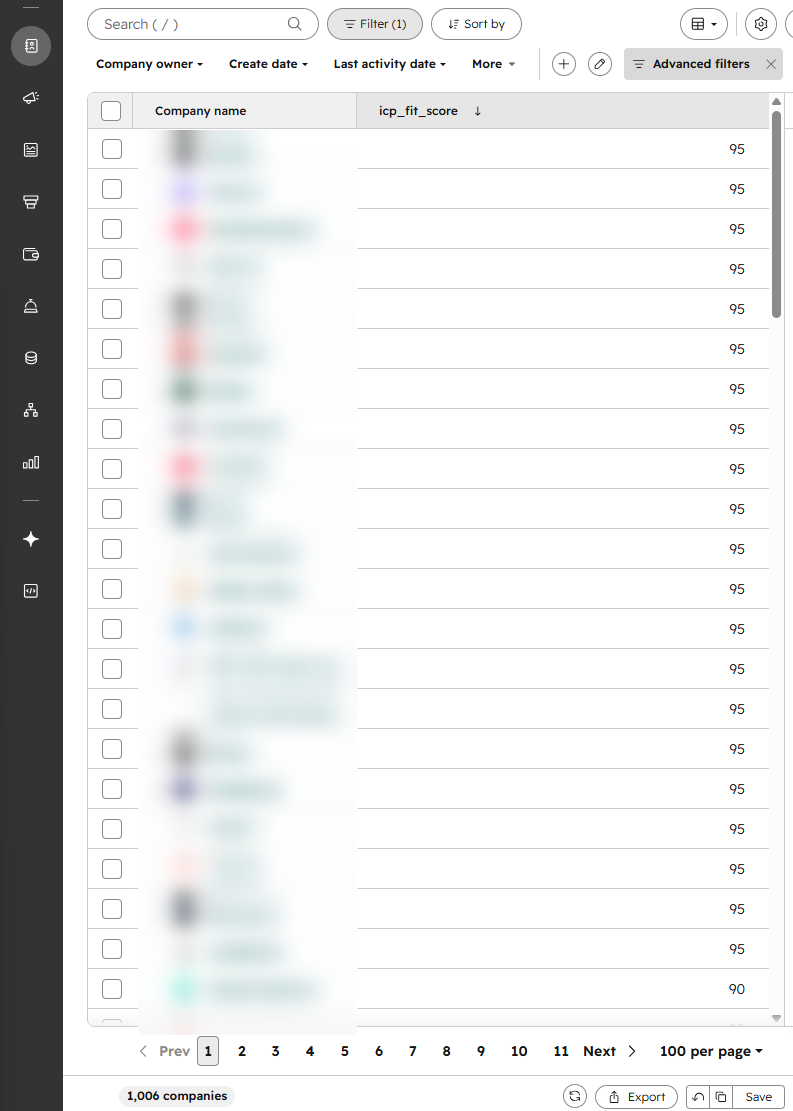
The leverage is the point. The system runs functions that would traditionally need three separate roles: someone doing outbound research, someone doing marketing operations, and someone doing analysis, all operated by one person. And it is not prompt-jockeying underneath. The scoring model runs on real statistical methods, logistic regression and random forest against a defined profile, not a guess dressed up as a score.
Building it taught me two things I didn't expect, and both are warnings for you. First, being easy to understand is not the same as being found when a buyer is deciding who to hire. When I looked closely, the engines could describe my firm but still leave it off the shortlist a buyer would actually use, and that gap is where deals quietly disappear. Second, and you saw this earlier: if your published footprint is thin, the machine fills the space with other people's words, borrowing a competitor's framework and handing it to you as fact.
Control your content, or the machine will define your positioning for you.
Why does this matter to you? The commentary on the AI shift is full of prediction and thin with proof. This is the opposite: first-person and drawn from a running system. That is scarce, and it is the whole reason to read a playbook from someone who built the thing rather than someone forecasting it. It also happens to be what the industry's own leaders are now describing: Flanagan has publicly explored the same shape, one operations leader plus a set of agents doing the work of a much larger team. The difference is that this runs for demand generation, today, as a business of one.
How do I find out where my firm actually stands?
You don't need anyone else to answer this for you. You can figure it out yourself this week, and it might be the most useful hour you spend on marketing this quarter.
Take the most important step, the way a new client currently finds you and becomes a conversation, and compare it to the four points. Is it clear, so a buyer outside your network could find and understand it without talking to you? Is it measured, so you can see if it's working or not? Is it defined, written down clearly enough that someone else could run it the same way twice? Is it ready to run, for a person today and an agent tomorrow? Every "no" is a specific fix, and the order you found them in is the order to address them.
Do that honestly and you will know something about your own business that most of your competitors do not know about theirs.
The machine is already here. The only question now is whether it finds a system to run or a mess to make bigger.
See where your firm stands.
Get your firm scored against the four marks, the same way the system in this guide scores a market. You'll get back a build order in sequence, not a sales pitch.
Score my firm →- "Introducing Salesforce Headless 360." Salesforce Newsroom, April 15, 2026.
- "AI Visibility Statistics (2026)." Boring Marketing (~6,982 AI-platform checks).
- Forrester, "2026 Buyer Insights" (Buyers' Journey Survey, ~18,000 global buyers), January 21, 2026.
- Forrester, B2B buyers' journey research (zero-click buying).
- Kieran Flanagan (HubSpot SVP, Agentic GTM & Systems), "GTM 165," GTMnow; Flanagan & Kipp Bodnar, Marketing Against the Grain / Loop.
- Gartner projection (~2027), referenced by Flanagan.
- Gartner, "Lack of AI-Ready Data Puts AI Projects at Risk," February 26, 2025.
- Forrester, "2026 B2B Marketing, Sales, And Product Predictions," October 28, 2025.